December 25, 2005 - Rather than spending Christmas Day at home doing nothing, I suggested to my parents that perhaps we should go watch a movie that day. Initially, we were going to see "The Family Stone", starring Diane Keaton and Sarah Jessica Parker (family comedy on Christmas Day is always a good thing, isn't it?) but since "Memoirs of a Geisha" was being shown at our local cineplex, we thought we would check out, mainly because we've heard so much about it and my parents would actually know who's-who in the movie (I don't think they even know who Sarah Jessica Parker is!).
Memoirs of a Geisha was adapted from Arthur Golden's best-selling novel, which describes the life of a young girl sold by her father to a Geisha house in pre-World War II Japan. The girl, named Chiyo, was to work as an unpaid servant until she is deemed to be elegant enough to work as a Geisha. The house is run by a woman named Mother and the house's ruling Geisha, Hatsumomo (Gong Li). Chiyo quickly becomes friends with another servant girl, Pumpkin, and together, the two learn the art of flattering wealthy men. After a failed attempt to escape from the Geisha house though, Mother decides that Chiyo should be kept as a servant girl and withdraws her from Geisha classes.
On her way to run an errand, Chiyo meets the Chairman (Ken Watanabee) and falls in love with the much much older man. The encounter supposingly changes her life, as she is now more than ever to become a Geisha, so she could be by the Chairman's side...
Years pass and Chiyo continues to suffer in the hands of Mother and Hatsumomo. Then one day, Hatsumomo's biggest rival, Mameha (Michelle Yeoh) decides to adopt Chiyo as her "younger sister", to help train Chiyo into a true Geisha. Why? so that Mameha can use the young girl to win control over Mother's Geisha House, who is expected to inherit the rein. Hatsumomo in return, decides to adopt Pumpkin as her student and the four ladies wage war against one another, complete with backstabbing, vicious rumour spreading, and even a cat-fight!
Chiyo is renamed Sayuri and quickly becomes the hottest Geisha in town. She meets the Chairman again (who has not aged one bit). World War II then intervenes and Sayuri/Chiyo's Geisha world comes crashing down...
The movie is not as bad as some critics might have you believe. It is one of most beautiful movies I have seen this year - the sets, the costumes are simply gorgeous. I can't believe they built the entire set in California. I also have no objection to having Chinese actresses playing Japanese characters - Ziyi Zhang, Gong Li, and Michelle Yeoh are all fantastic actresses with more than enough beauty to pull of as great Geishas. The comment that it's "ethnically incorrect" to have Chinese actresses playing Japanese roles is absurd - American actresses play British characters all the time and nothing is ever said, same with Australian actresses (i.e. Nicole Kidman, Naomi Watts) playing American characters. It's called ACTING - if they can pull off the role, which in this case all three actresses do, then what's wrong with that?
However, what I didn't like about the movie was that it felt so Americanized. The movie feels like a Japanese version of "Desperate Housewives" or "Days of Our Lives" - and it really makes you wonder if Rob Marshall, the director, purposely changed the authentic feel of traditional Geisha culture so that American audience won't get lost (hence the inclusion of the cat-fight scene). Also, I failed to see the love connection between Chiyo and the Chairman. Was it love at first sight or was she using him to move up the social ladder? and the Chairman - was Chiyo simply a tool for him to regain his financial success after World War II? Also, does anyone feel icky over how Chiyo, as a 9 year old girl, fell in love with this 30+ year old man? In terms of character development, I really didn't feel attach to the characters at all. I didn't really care about Chiyo/Sayuri - sure, I felt bad that she was sold to the Geisha house etc, but the movie did a poor job in making me care about her life...
Having said all that, I was told that the book is much better and much more powerful in telling the tale of Chiyo/Sayuri. The book is currently sitting on my bookshelf....
Interesting note:
On a recent visit to Tokyo to promote the film, Ziyi Zhang received a mysterious parcel and letter, revealed to have been sent by an elderly Japanese woman who had once worked as a geisha. In her letter, the woman stated that she had been touched by the trailer of the film and expected the movie to bring back fond memories for her and her friends. Inside the parcel were several exquisitely worked antique kimono. Zhang was moved to tears by the gesture and sent the woman an invitation to the film's Japanese premiere.
Interesting link:
Check out Mad TV's version of Memoirs of a Geisha - it's hilarious!
http://www.youtube.com/watch.php?v=_AQvqsZFgDY&search=mad%20tv
 December 24, 2005 - With so many movies having been released over the past couple weeks, I decided to try to watch as many movies as possible over the Christmas-New Years break from work. Having watched King Kong on Tuesday, tonight (on Christmas Eve), I had the opportunity to watch The Chronicles of Narnia: The Lion, the Witch and the Wardrobe, adapted from one of the most beloved classics of all times.
I have been preparing to watch this movie for awhile now! Even though I read most of the books in the series when I was in elementary school, I have pretty much forgotten the story. So in an attempt to prepare myself to watch the film, I bought the Narnia book set in the fall, thinking that I could get through at least the Lion, the Witch and the Wardrobe (which is actually book 2 in the series, with the Magician's Nephew being the first) by December.
How wrong I was - by the time I reached the movie theatre, I was only on page 100 of the book - and that was only because I made myself sit down and read the book hours prior to watching the movie.
The movie begins with the bombing of London during World War II, as a mother and her four children run for their lives. Middle child Edmund decided to run back to the house to grab his dad's picture (who was at war), prompting big brother Peter to send out the first message set out by Narnia: thou shall not be selfish.
The children are then sent to live with an old professor out in the country, in a big house full of empty rooms and nothing for kids to do. A game of Hide-and-Seek leads youngest child Lucy to step inside a wardrobe and into Narnia. Narnia is a fantasy world full of dwarfs, fauns, and talking animals. Lucy meets up with a faun named Mr. Tumnus and learns of an evil white witch (Tilda Swinton) who has proclaimed herself as the Queen of Narnia. The Queen devoids Narnia of happiness, warm weather, and most importantly, Christmas.
Eventually, the other children follow Lucy into Narnia, but poor Edmund is unfortunate enough to meet the White Witch. Under magic, Edmund betrays his family to the witch - for something called Turkish Delight (which is apparently some sort of sweet baked good), as the White Witch slowly realizes that these four children could be the ones mentioned in an ancient prophecy, one in which the White Witch's reign would come to an end when these four children are crowned as the Kings and Queens of Narnia. Edmund is then captured by the White Witch and the remaining three children's best hope of rescuing Edmund is with the help of Aslan the Lion...
The movie did a great job in adapting the novel (much better than Harry Potter and the Goblet of Fire, though to be fair, the Lion, the Witch and the Wardrobe is a much shorter book) and successfully brought these much loved characters to the screen. C.S. Lewis had famously said he never wanted this Narnia books to be made into movies, for he feared that the animals in the books would be turned into some sort of cartoonish characters. This movie, with the help of CGI technology, not only made the animals as real as the human characters, but also brought style, wit and personality to these creatures.
While there has been no official comment that the other books in the series would be made into film, I have no doubt that all of the books will make great movies. Not sure when the next movie will come out, but hopefully by then, I would have finished all 7 books in the series (ya right..).
 December 2, 2005 - Despite having been to Montreal on numerous occasions, I have never really felt too much for the city. I guess the reason for that is I have never truly experienced first hand, for all my visits have either been in a tour bus (those "Canada-East" bus tours) or with my parents in a car. It's unfortunate because I have just recently discovered how architecturally stunning the city really is and now I'm dying to visit the city - preferably on foot and on the local transit system. Well better late than never I guess.
So I did a little research on Montreal's Metro (subway) system and to my (somewhat) surprise, the city has one of the most architecturally distinctive underground transit systems in North America. Unlike the TTC, each subway station in Montreal is unique, beautifully decorated with sculptures, stained glass, and other public art. As our commutes become longer than ever, having an aesthetically beautiful transit system, such as Montreal's can make long rides more appealing and more relaxing.
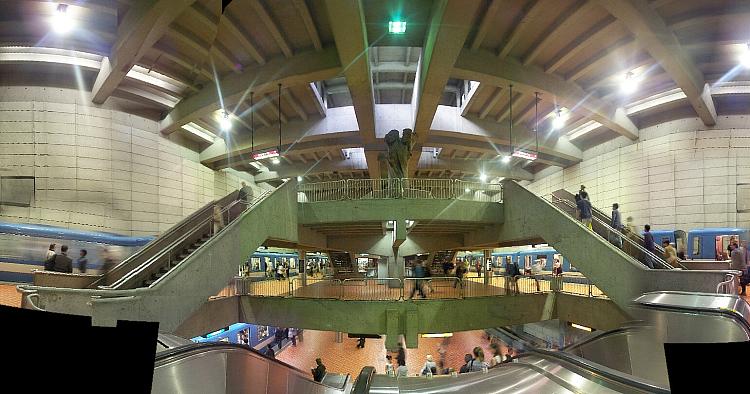
 Every building, subway entrance, and platform in Montreal's metro system were designed to be a piece of art. Check out the transfer escalator at Lionel-Groulx Station (see right) - it was specifically designed to create a sense of openness, while at the same time functional - passengers can transfer between different lines simply by walking across the platform (no more going up and down the stairs, like at St. George and at Bloor-Yonge). Pretty cool huh?

The newer stations also make good use of their local environment. For example, Angrignon Station (see below) is located in a park. To make the presence of the park felt throughout the station, architects put big windows throughout the length of the platform and created a grassy slope with small trees alongside the platform. The slope brings the park to transit riders at the platform, and also brightens the station.
There are many other cool pieces of art that can be found in the city's Metro system - I can go on forever here, but I figured the best way to really talk about the Metro system is after I've seen it (which hopefully will be soon!). In the mean time check out this site: http://www.metrodemontreal.com/index-e.html
December 1, 2005 - The announcement made yesterday by the Toronto Community Foundation and the TTC on revitalizing our subway stations through art got me thinking about what other cities have done to make their underground transit systems not as just means of transport, but something that can foster the cultural and aesthetic aspects of the city.
Most subway systems are unfortunately quite dull from an aesthetic point of view. The stations along the Bloor-Danforth Line in Toronto, for example, look more or less the same, except for the colours of the tiles. On the other hand though, there are cities that work hard to foster arts and good architectural designs in their underground transit systems. Some of these subway systems act as the city's art galleries, museums, and even aquariums. These user-friendly, aesthetically pleasing stations have been said to help improve ridership and to reduce vandalism and crime. To no one's surprise, most of these artistic subway systems are found in Europe. Check out some of the ones that I've found:
 1) Stockholm, SwedenKnown as the World's longest art gallery, art has been integrated in every single one of Stockholm's subway stations since it opened in 1950. Most stations have been left as rock caverns, which gives them an authentic, ruggish look. Together with special lighting, these stations are not just transit stops, but a master piece of art.
This is T-Centralen Station, one of the busiest stations in Stockholm. Doesn't this beat the tiles at Yonge-Bloor?
 2) Paris, France
Perhaps the first city to incorporate art into its subway system, Paris' Metro is best known for its distinctive art-deco entrances (this one is at Abbesses Station). Paris' metro stations are column-free vaults that look similar throughout the system. The older stations (particularly those close to tourist attractions) are better looking than others and have a more historical appeal to them. Two interesting things that I discovered when I rode the Metro system last summer on my visit to Paris: the trains run on rubber wheels, not tracks; you have to open the train doors manually! One of the cons: someone needs to do something about the smell at some of these stations...
 3) Moscow, Russia
No, you're not looking at a grand hall inside a castle! This is the platform at Komsomolskaya Station in Moscow. Opened in the 1930s, the Moscow's subway stations were designed to be grand outstanding spaces, resembling cathedrals and castles. Many of the stations have marble-clad walls and chandelier lighting. A little creepy for my taste really, but these stations were designed under the Socialist Regime of the former USSR and were intended to be "palaces for the people". Other former USSR cities, such as Kiev in Ukraine, also have similar designs for their subway stations.
 4) Bilbao, Spain
Internationally known for being the home to Frank Gehry's Guggenheim Museum, Bilbao has also invested billions of dollars to improve the visual landscape of the city through public art and good architecture. Check out the glass entrance to Abando Station. The system was designed by an architect named Sir Norman Foster, who said "A tunnel dug by man through earth and rock is a very special place. Its shape is a reaction to the forces of nature and the texture of its construction bears the seal of man. This must be respected, not covered up to make the place look like any other building. One must be able to feel being underground, and make it a good, special experience."
 5) Rhine-Ruhr, Germany
The Rhine-Ruhr region in Germany consists of close to 30 different tram and subway (called Bahn in Germany) lines. Many of the newer stations have interesting designs, mixing different types of materials (such as wood with concrete) with lighting. My favourite is Neue Mitte Station (shown left), which was probably influenced by deconstructivist architecture. Wouldn't it be cool if they decide to redesign Yorkdale Station or Scarborough Town Centre Station in a similar fashion?
Many other subway systems in other parts of Europe have also begun to incorporate art into their station design. The new subway system in Athens for example, has Greek sculptures and statues scattered throughout. For an upcoming post though, I'll see if I can find examples of subway art and architecture in North American subway systems...
 December 25, 2005 - Rather than spending Christmas Day at home doing nothing, I suggested to my parents that perhaps we should go watch a movie that day. Initially, we were going to see "The Family Stone", starring Diane Keaton and Sarah Jessica Parker (family comedy on Christmas Day is always a good thing, isn't it?) but since "Memoirs of a Geisha" was being shown at our local cineplex, we thought we would check out, mainly because we've heard so much about it and my parents would actually know who's-who in the movie (I don't think they even know who Sarah Jessica Parker is!).