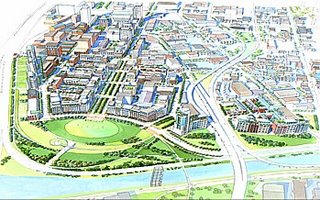
 March 31, 2006 - The media has been buzzing the past couple of days over news of the latest waterfront development: the West Don Lands community. The West Don Lands is a 32 hectares site located east of downtown Toronto, in between Parliament Street and the Don River, and King Street and the rail corridor. Currently, the site consists of abandoned factories, derelict buildings, and open land that people seem to use as dump sites. The Province, along with its federal and municipal counterpart, recently pledged $230M to clean up the West Don Lands and create a new mixed-use community for about 11,000 people.
Highlights of this new community include:
- 6000 new residences, including 1500 units of affordable rental housing
- 25% of community to be parks and public space including the eight-hectare Don River Park
- A new light rail transit line (LRT) within a five-minute walk of all homes
- Two childcare centres
- Community centre and pool
- Elementary school
The West Don Lands is just one of Toronto's key Waterfront Projects (others include Lake Ontario Park, the Portlands, Union Station expansion, etc). But despite having established the Waterfront Revitalization Corporation in 2001 to carry out Waterfront projects, to date, little has been done. Spiraling costs and disagreements between different levels of government and citizen groups have caused delays and frustrations among those who are eager to see something (anything!) happen on the waterfront.
The new West Don Lands will incorporate all of the latest sustainable planning principles: mixed-use, high density, a new streetcar line, parks (yay!), and different types of housing. Politicians are already calling it the second St. Lawrence - the award winning neighbourhood that wowed planners around the world just 30 years ago.
Some critics have argued that given the government's previous failure to revitalize the waterfront (the previous Ataratiri neighbourhood project cost the government $350M before the Province finally pulled the plug), the entire waterfront should be sold to developers and let the private sector develop it. While this approach will definitely speed up the development process, turning such valuable waterfront land to developers will likely recreate what we are already seeing in harbourfront west: a wall of condos, with little diversity in landscape or in public space. Now that we have a second change to develop a water-class front, we should take advantage of this opportunity and develop something we can all be proud of.
 March 29, 2006 - Who says living in the suburbs has to be boring?
The City of Mississauga recently held an international architectural contest for its Absolute Downtown landmark near the city's civic square and Square One shopping centre. The competition attracted architects from around the world, with submissions that look more like sculptures than buildings. Click here to see all the submissions.
Yesterday, the City announced the winning design - Chinese Architect Yansong Ma won the competition with his "Marilyn Monroe" condo tower - nicknamed so because of the building's curves. It wasn't the design that I voted for - I voted for the design by Tarek El-Khatib (the last finalist), but I'm not complaining. The condo tower will definitely bring a new sense of architectural uniqueness to the otherwise bland landscape of the city. It's also interesting that it's the private developers who are leading the way towards this new architectural renaissance in Mississauga (and not the City's planning department).
Speaking of Mississauga, the City also recently commissioned Projects for Public Spaces (PPS) for help in revitalization the public spaces in around the downtown area, with a particular focus on creating new parks and open spaces in the city centre. PPS held a series of workshops with city planners and citizens on ideas and strategies to place making. PPS made a series of recommendations, including creating a permanent farmers market on the Square One parking lot, turning Burnhamthorpe Road into a grand boulevard, and improving access to public transit in the downtown core. Click here for PPS's full report.
 March 27, 2006 - Just days after the Spadina Subway extension announcement, today's Toronto Star featured an article on "Vaughan's Downtown Dream". Planners and politicians in Vaughan, which has long declared itself as "the city above Toronto", have been hoping to create a 600 acre downtown called Vaughan Corporate Centre near the Highway 7-Jane Street area for almost a decade. With the subway extension, it looks like the dream will now become a reality.
As the City is building the Corporate Centre from scratch, downtown Vaughan has the potential to become a true walkable, mixed-use, transit-friendly city centre. Plans call for a 6.1 million square feet of both residential and commercial development, including hotels, office towers, cultural facilities, restaurants, and entertainment venues, along with medium and high density mixed types of housing (no word on whether there will be affordable housing though). Early estimates are that 30,000 people will work there and at least 5,000 will live there. Currently, the Corporate Centre is nothing more than open fields, big box stores (i.e. IKEA, AMC, Vaughan Mills), and light industries.
Now this development plan sounds great on paper, but I still have my doubts as to whether it could truly become what it wants to be. For one thing, Vaughan is still a predominately suburban community (even more so than Markham I would say). Cars rule in Vaughan - both Highway 7 and Jane Street today are 8 wide lanes of traffic. Getting to Vaughan is also quite difficult - public transit, even with the new Viva Line continues to be poor. Would the subway help? While the subway will improve access, it will take almost 6 times as long for downtown Vaughan to be completely built than the subway. Ridership on the new line will be extremely low for years and may not even be economically sustainable (note: the Vaughan Orange Viva Line has the lowest ridership among all the lines). Not to mention, will downtown Vaughan be able to attract enough businesses so that residents can "live and work" in the area? or will the city centre but nothing more than a commuters hub? Also, with multiple developers eager to build in the Corporate Centre (unlike Downtown Markham, which only has 1 developer), will there be a consistency in terms of urban design?
Well I guess time will tell. I think I have my doubts because Vaughan isn't exactly known for its good planning (Vaughan Mills anyone?). So I guess until I actually see the draft plans, I will have some reservations...
 March 24, 2006 - The Province of Ontario announced yesterday that they will offer $670M to extend the Spadina subway north to Vaughan as part of a $1.2B program called Move Ontario, which is designed to help fund public transit, roads and bridges throughout the province. The subway extension marks the first time that the subway will cross the city limit to the 905 region, and it also marks the first subway expansion since the Sheppard subway opened in 2002.
The subway will help fight congestion in the 905 region and will also serve York University, which currently is one of the busiest transit hubs in the city. With the extension, passengers in the 905 can begin and end their commute at the new Vaughan Corporate Centre station, thereby relieving traffic at Finch Station (currently the northern most station on the subway).
Now as a planner, any subway expansion should be regarded as good news. The City definitely needs new transit infrastructure and expanding the Spadina subway to Vaughan represents a new Region-wide vision that is strongly needed in managing traffic gridlock in the GTA. Not to mention any government funding in public transit should call for celebration!
But at a deeper level, one have to wonder whether expanding the subway to a low-density suburb is the best way to spend nearly $2B (the total cost of project) of transit funding. Already, critics have argued that the under-utilized Spadina subway will not meet the passenger projections stated in the subway expansion proposals. Vaughan Corporate Centre is currently nothing but open space, big box stores (Vaughan Mills and IKEA), and low density communities - it would take over 30 years for Vaughan to develop into the minimum level required to successfully support public transit. Having learned from the mistakes made with the Sheppard subway (which till this day, continues to be only half-full even at rush hour), why weren't other options more seriously considered? For example, wouldn't a LRT line would cheaper, more efficient, and still achieve the goals of creating transit-friendly sustainable communities?
Not to mention, at a time when the TTC barely have enough money to maintain the service it provides, shouldn't the money be put back into the existing system first? How about more funds to improve subway efficiency, or more buses on the busiest routes, or perhaps, maybe tearing down the old and crumbling Scarborough LRT?
We all know that this subway expansion is more political than sensible. While there certainly are advantages to expanding the Spadina Subway to Vaughan, I don't know if it's the best way to spend precious transit funding, particularly when so many other initiatives require our attention now.


